Why Microservices Fail Without Domain-Driven Design
Microservices have become the go-to architectural choice for many organizations aiming for scalability and agility. However, many teams rush into microservices without proper domain modeling, leading to common pitfalls such as chatty services, tight coupling, and unmanageable complexity. This often results in a distributed monolith—an architecture that carries all the downsides of microservices without their benefits.
The core reason behind these failures? A lack of Domain-Driven Design (DDD).
The Importance of Bounded Contexts
One of the key principles of DDD is Bounded Contexts—a way of defining clear boundaries between different parts of a system based on business domains. In microservices, each service should correspond to a distinct Bounded Context, ensuring that services encapsulate specific business logic and do not leak internal details to others.
Example: Poor Microservice Design
A common mistake is defining services around technical concerns rather than business needs. Take the following design:
UserService: Manages user profiles, preferences, and authentication.
OrderService: Handles order placement and tracking.
PaymentService: Processes payments.
At first glance, this separation looks reasonable, but the problem arises when services become too dependent on each other. Imagine the following workflow:
The
OrderServiceneeds user details before processing an order, so it callsUserService.OrderServicealso needs to validate payment status, so it callsPaymentService.PaymentServicein turn checksUserServicefor billing details.
This results in synchronous dependencies, leading to high network latency and cascading failures if one service is down. The microservices are tightly coupled, violating the independence principle.
A Better Approach Using Bounded Contexts
Instead of a technically defined architecture, we should structure services around business functions:
CustomerContext: Manages user accounts and loyalty programs.
OrderingContext: Handles order placement and processing.
BillingContext: Processes payments, invoices, and refunds.
Each context publishes domain events instead of making direct calls:
OrderingContextemits anOrderPlacedevent.BillingContextlistens toOrderPlacedand handles payment processing asynchronously.CustomerContextlistens for payment events to update loyalty points.
This approach eliminates tight coupling and makes the system more resilient.
Using Aggregates to Define Microservice Boundaries
What Are Aggregates?
In DDD, Aggregates are clusters of domain objects that should be treated as a single unit. They help maintain consistency by ensuring that related changes are handled together.
Example: Product Inventory
A poorly designed microservices system might look like this:
ProductService: Stores product information.
InventoryService: Tracks stock levels.
OrderService: Handles customer orders.
Bad Design (Tightly Coupled Services)
If an order is placed, the OrderService directly calls InventoryService to check stock and update availability:
GET /inventory/{productId}
PATCH /inventory/{productId} - decrease stock
This setup creates tight coupling and can lead to race conditions where multiple orders are processed simultaneously, causing incorrect stock counts.
Better Design (Using Aggregates)
A Product Aggregate should include inventory as part of its domain logic:
OrderServiceemits an OrderPlaced event.InventoryServicelistens to the event and updates stock asynchronously.A Saga pattern or event-driven workflow ensures consistency across services without direct API calls.
This approach improves resilience and scalability.
Avoiding Chatty Microservices
One of the biggest mistakes in microservices architecture is excessive inter-service communication. Every synchronous API call between microservices adds network latency, increases the chance of failure, and reduces scalability.
Example: Chatty Communication
A traditional implementation might involve:
CheckoutServicecallingUserServiceto fetch user details.CheckoutServicecallingOrderServiceto create an order.OrderServicecallingInventoryServiceto check stock.InventoryServicecallingShippingServiceto verify delivery options.
This results in multiple synchronous API calls for a single transaction.
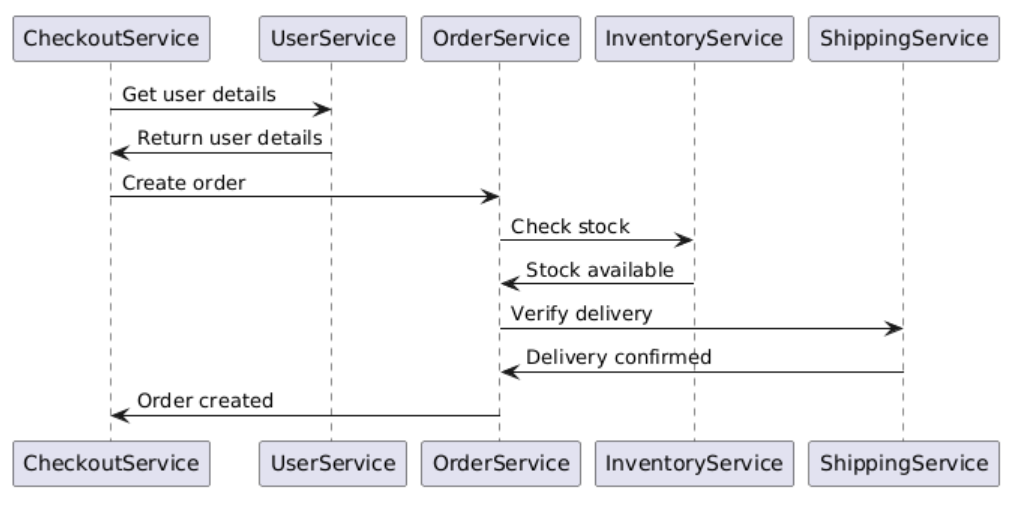
In this approach, each service directly calls another service, creating tight coupling and a high risk of failure propagation.
Solution: Asynchronous Messaging
Instead of direct calls, use event-driven communication:
CheckoutServiceemits an OrderInitiated event.OrderServicelistens and processes the order.InventoryServicelistens and reserves stock.ShippingServicelistens and schedules delivery.
Using message queues (Kafka, RabbitMQ, AWS SNS/SQS) reduces dependencies and improves fault tolerance.
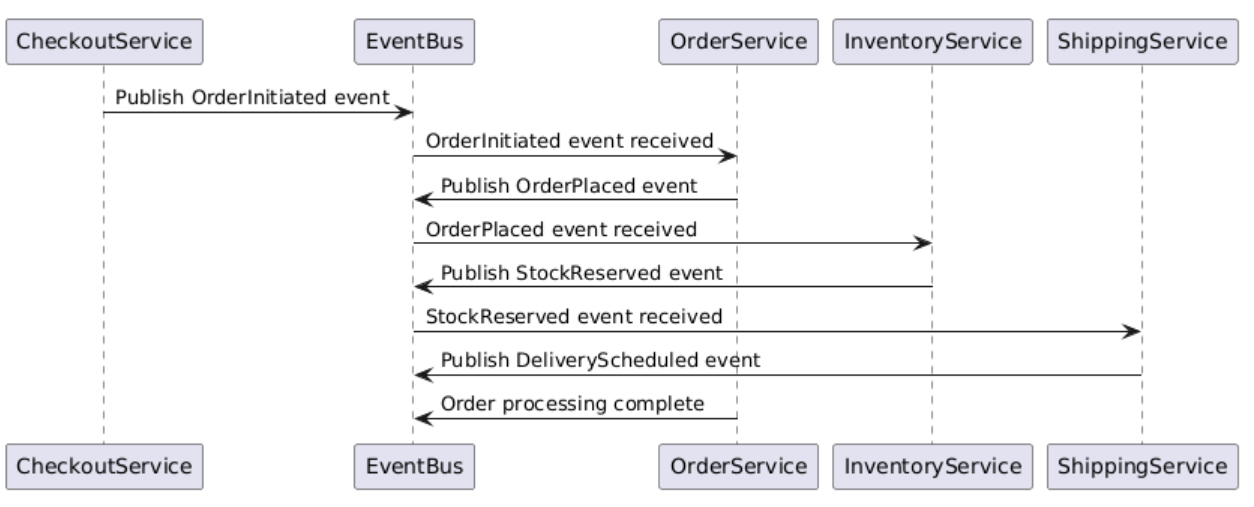
Here, services communicate via events, reducing dependencies and improving resilience.
Anti-Corruption Layers: Protecting Domains from External Changes
Sometimes, microservices need to interact with legacy systems or third-party APIs. Without proper boundaries, these dependencies can leak into the domain model, leading to brittle integrations.
Solution: Anti-Corruption Layer (ACL)
An ACL acts as a buffer between the microservice and external systems:
Translates external API responses into domain-specific objects.
Shields internal models from external system changes.
Provides backward compatibility when migrating from a monolith.
Example: Instead of OrderService directly calling a third-party payment processor, an Anti-Corruption Layer abstracts the payment API and translates its response into a PaymentCompleted domain event.
Conclusion: Microservices Work Best with Strong Domain Boundaries
Microservices alone do not solve scalability and maintainability issues—proper domain modeling is essential. By using Bounded Contexts, Aggregates, Domain Events, and Anti-Corruption Layers, teams can create microservices that are truly independent, scalable, and resilient.
Key Takeaways:
✅ Define microservices based on business domains, not database tables.
✅ Use domain events for asynchronous communication instead of direct API calls.
✅ Apply Aggregates to maintain consistency within a domain.
✅ Avoid chatty services by using event-driven architectures.
✅ Use Anti-Corruption Layers to protect services from external dependencies.
With these principles in place, microservices can deliver on their promise of scalability and flexibility, rather than becoming a distributed monolith.
Would love to hear your thoughts! Have you encountered microservices that suffered from poor domain design? Let’s discuss in the comments!